
Commercial Kitchen Trench Drains
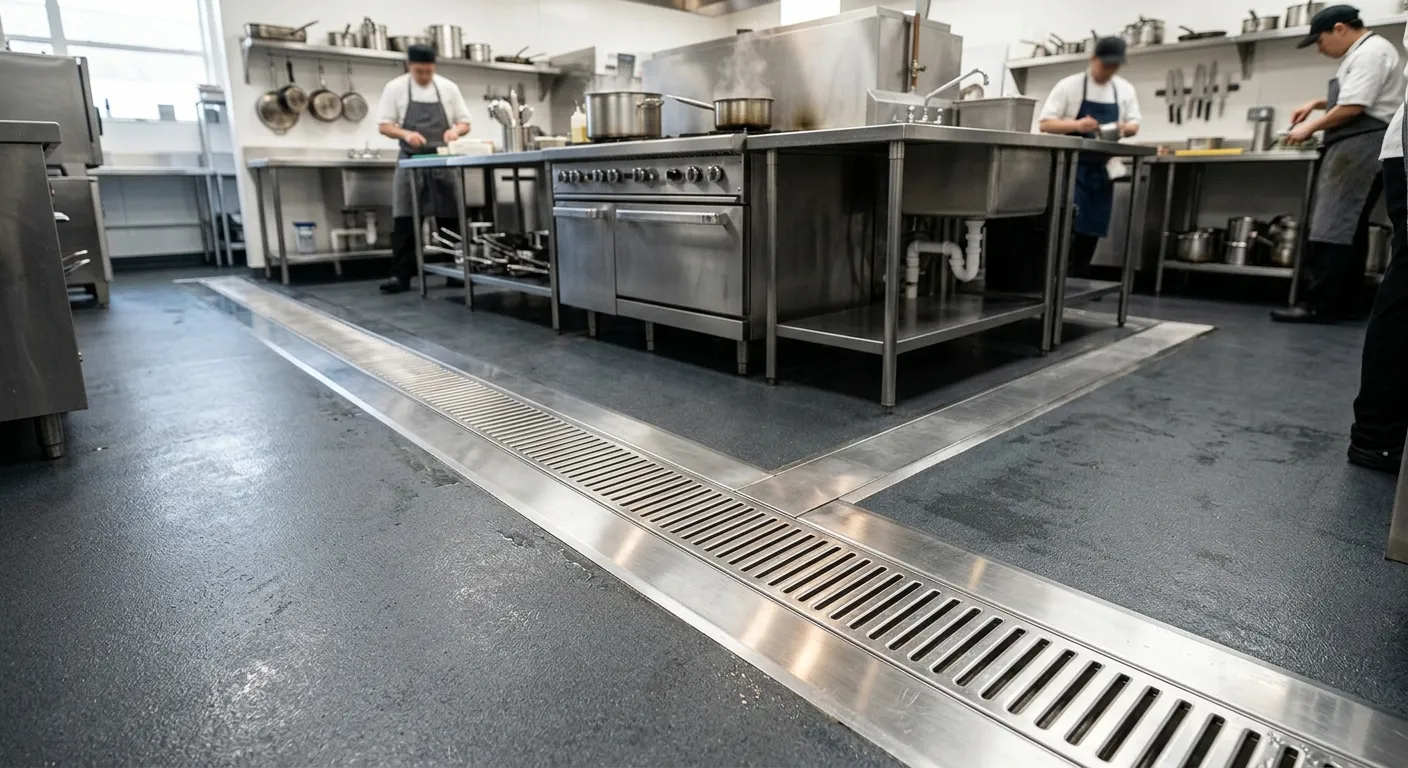
Grease-compliant trench drains for commercial kitchens and food service areas. Designed to meet health department standards with proper slope, material selection, and easy cleaning access.
Key Features
- 316 stainless steel for chemical resistance
- Heavy-duty load-rated grates
- Removable sediment baskets
- Compliant with NSF and health codes
- Sloped channel design for complete drainage
- Available in standard and custom lengths
- Slot or grate-style cover options
- Easy-clean internal geometry
Materials & Specifications
Available Materials
Ideal For
Product Details
Technical Specifications
| Flow Rate | 60-80 L/min (depending on channel width) |
| Channel Width | 150mm (standard), 200mm (high-capacity) |
| Outlet Size | 75mm or 100mm |
| Channel Slope | 0.5% minimum (pre-sloped) |
| Material | 316 Stainless Steel (all components) |
| Steel Gauge | Body: 1.5-2.0mm, Frame: 2.0-3.0mm |
| Grate Options | Slot (15-20mm), Perforated (6-8mm), Bar grate |
| Load Class | Class K-L (pedestrian to light vehicular) |
| Length Options | Custom lengths up to 6m per section |
| Compliance | NSF/ANSI, EN 1253, ASME A112.6.3 |
Installation Guide
Designing a Commercial Kitchen?
Our technical team can provide trench drain layouts, flow calculations, and specification documents for your kitchen project.
Request Technical SupportFrequently Asked Questions
Why is 316 stainless steel required for commercial kitchen drains?
Commercial kitchens expose drains to a uniquely aggressive environment: (1) Hot greasy effluent at 60-90°C containing animal fats, vegetable oils, and food acids (pH 3-4); (2) Aggressive cleaning chemicals including caustic soda (pH 12-14), acidic descalers (pH 1-2), and chlorine-based sanitizers; (3) Salt from food preparation which introduces chlorides that attack standard stainless steel. 316 stainless steel contains 2-3% molybdenum, which provides superior resistance to chloride-induced pitting corrosion and chemical attack. Many health codes (NSF/ANSI, local health departments) specifically require 300-series stainless steel for food service drainage, with 316 being the preferred grade for commercial kitchens. Using 304 grade in a commercial kitchen typically results in visible corrosion within 1-2 years of operation.
What slope should commercial kitchen trench drains have?
Commercial kitchen drainage requires two slope systems: (1) Floor slope: The kitchen floor should slope at a minimum of 1:80 (1.25%) toward the trench drain, with many health codes requiring 1:50 (2%) slope. The slope should run from walls and equipment toward the trench, with no flat areas or low spots; (2) Channel slope: The trench drain channel itself should have a built-in slope of 0.5% minimum (1/8" per foot) to ensure complete drainage and prevent standing water. Our trench drains are manufactured with pre-sloped channels for optimal performance. For kitchens longer than 15 meters, we recommend a center outlet configuration with slope in both directions to maintain the 0.5% minimum channel slope.
Do your kitchen trench drains meet NSF requirements?
Our 316 stainless steel commercial kitchen trench drains are designed to meet NSF/ANSI standards for food equipment and plumbing fixtures. Key NSF compliance features include: (1) 300-series stainless steel construction (316 grade) for corrosion resistance and cleanability; (2) Smooth, crevice-free internal geometry that prevents bacterial harborage; (3) Complete drainage without standing water (pre-sloped channels); (4) Removable components (sediment baskets, grates) for easy cleaning access; (5) No threads or mechanical fasteners inside the flow path. Specific NSF certification can be arranged for large project orders. We provide pre-written specification sections and technical documentation to support your health department submission.
What grate options are available for kitchen trench drains?
We offer three grate configurations optimized for commercial kitchen environments: (1) Slot-style grate (15-20mm slot width) — our most popular kitchen option. The narrow slots prevent large debris (food scraps, packaging) from entering the channel while providing excellent slip resistance even on wet, greasy floors. Flow capacity is 50-65 L/min; (2) Perforated grate (6-8mm round holes) — higher flow capacity (65-80 L/min) with slightly reduced slip resistance. Suitable for areas with lighter kitchen traffic or where higher flow is needed; (3) Heavy-duty bar grate — for areas subject to cart, dolly, or forklift traffic. Provides maximum load capacity (Class L/M) and excellent slip resistance. All grates are removable for channel cleaning access and are manufactured from 316 stainless steel.
How do I size a trench drain for my commercial kitchen?
Trench drain sizing depends on kitchen size, equipment count, and expected flow volume. As a general guideline: (1) Small kitchen (restaurant, café): 150mm wide channel with 75mm outlet; (2) Medium kitchen (busy restaurant, institutional): 150-200mm wide channel with 75-100mm outlet; (3) Large kitchen (hotel, hospital, food processing): 200mm wide channel with 100mm outlet. The trench should run along the length of the wet area, with the outlet positioned at the lowest point connected to an appropriately sized grease interceptor. Our technical team can provide detailed flow calculations and trench drain layouts based on your kitchen equipment list and floor plan. Contact us with your kitchen layout for a customized drainage recommendation.
What is the lead time for custom kitchen trench drain orders?
Standard trench drain configurations (150mm width, standard lengths of 1-3m) ship within 2-3 weeks. Custom lengths, specialized grate configurations, and OEM-branded orders typically require 3-5 weeks depending on order volume. For large project orders (10+ sections or custom designs), we recommend placing orders 6-8 weeks in advance. Rush orders can typically be accommodated within 2 weeks. We provide detailed production scheduling and tracking for all orders, and our project management team coordinates directly with your contractor to ensure on-time delivery.
Request Commercial Kitchen Trench Drains Samples & Pricing
Get product samples, technical datasheets, and competitive OEM pricing from our team.